eCommerce & Marketplaces
Orders, products, prices and stock synced with your online stores and marketplaces.
- Shopify
- WooCommerce
- Magento
- Amazon
- eBay
- Flipkart
ERP Integration
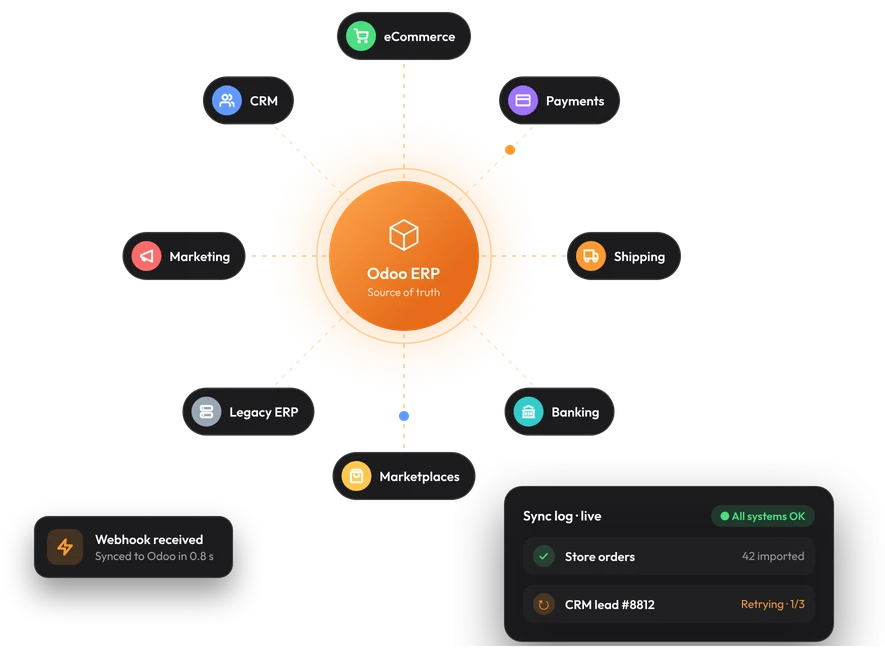
We connect your eCommerce, payment, shipping, CRM and finance tools to Odoo, so data syncs automatically and every team works from the same figures.
Plan Your Integration
Our Odoo Integration Services
Online stores, payments, shipping, CRM and finance, all syncing with Odoo so nobody re-types data again.
Orders, products, prices and stock synced with your online stores and marketplaces.
Payments posted to Odoo Accounting and reconciled automatically, fees included.
Carrier rates, labels and tracking brought into Odoo Inventory and Delivery.
Leads and contacts kept in two-way sync with your CRM and email tools.
Bank feeds, statement imports and tax or e-invoicing tools connected to Odoo.
In-house or older software linked to Odoo, even without a ready connector.
Our Approach
Four rules we follow on every integration, so your data stays right long after launch.
Each record has one owning system, so prices, stock and customers never conflict.
Official APIs, webhooks and proven connectors come before any custom code.
Every sync is logged, failed calls retry, and your team is alerted if a person must step in.
Connectors sit in separate modules, so Odoo and platform updates don’t break them.
Integration Examples
A few examples of how businesses use Odoo integrations to remove manual work.
Retail
Shopify orders, customers and payments flow into Odoo, and stock updates return to the store after each sale.
Distribution
Amazon and eBay listings, prices and stock managed in Odoo, with orders routed to the right warehouse.
Logistics
Carrier rates compared at dispatch, labels printed in one click and tracking emailed to customers.
Finance
Card payments, fees and payouts reconciled automatically in Odoo Accounting.
Services
HubSpot leads and deal stages sync both ways with Odoo CRM.
Manufacturing
Orders and stock sync between a legacy ERP and Odoo, enabling a phased move with no downtime.
How We Integrate
A clear six-step process with a written data map and a fixed price before any build starts.
Most integrations go live in 2–5 weeks*Simple connectors can take days. Multi-system projects are phased with fixed scope.
An inventory of your tools, the data they hold and where it needs to go.
Fields, formats and sync rules agreed in writing, with a fixed-price quote.
Proven or custom connectors built using APIs and webhooks.
Staging tests, including error and retry cases, signed off by you.
A safe first import on launch day, with a rollback plan ready.
Sync logs, failure alerts and fixes whenever a connected API changes.
Engagement Models
One connection, ongoing support, or a developer on your roadmap. Choose what fits your plans.
A defined scope for an agreed price and timeline.
Best for: one-off connections
Get a QuoteEverything in Fixed-Price, plus monthly sync monitoring and priority fixes.
Best for: businesses relying on live sync
Plan My IntegrationA certified developer working on your priorities, scaling month to month.
Best for: many systems or a growing roadmap
Hire a DeveloperWhy Choose Mindphin
Developers who know Odoo’s APIs and the platforms around it, with live data, automated processes and room to add new tools later.
Let’s Get StartedTrusted By Our Clients
4.9 / 5
Rated for customer satisfaction, with 5-star reviews from Odoo clients on Upwork.
I preferred Mindphin as a long-term technology partner because they are committed to offering faster responses with quick solutions.
The development allows the internal team to be more efficient. The team is hard-working and talented.
They have administrative overhead reduced to a minimum, which is key for speed and business.
FAQ
Common questions about connecting your tools to Odoo. Ask us anything else.
Ask Us AnythingAlmost any system with an API, including online stores, marketplaces, payment gateways, carriers, CRMs, banks and in-house software. We use existing connectors where possible and build custom ones where we need to.
Both. If a proven connector covers your needs, we set it up and test it. When it doesn’t, or the system is in-house, we build a custom connector as a separate Odoo module.
It depends on the systems, the amount of data and how often it syncs. After a short audit we share a written data map and a fixed-price quote, so you know the cost before any build starts.
It can be. Webhooks push changes within seconds where the other system supports them. For the rest we schedule syncs, for example every few minutes or each night, based on what your team needs.
Every sync is logged. Failed calls retry automatically, and if a record still can’t go through, your team gets an alert with the reason so it can be fixed quickly.
We build connectors as separate modules on official APIs, which keeps upgrades simple. When you upgrade Odoo or a platform changes its API, we test and update the connector as part of support.
Let’s understand where your business is today, explore what’s possible with Odoo, and find the right way forward.